
Big Ears 2025

This past March, I attended Big Ears festival and wrote a festival report that was supposed to be one piece of a bigger set of coverage that, for reasons that had nothing to do with me, never got published. Being me, I naturally focused (but not exclusively) on the experimental folk music at the fest, and I did separately publish an interview I did with Brìghde Chaimbeul. I don’t know if this is still of interest to anyone, but if for no other reason than to prove I did write the thing in case the PR folks reviewing my press pass request for 2026 see this, here’s my report.
When I started attending Big Ears over a decade ago, it was for me a jazz festival. My own background was in folk and classical, but I had never had an opportunity to see artists like Henry Threadgill, Anthony Braxton, William Parker, and Mary Halvorson in central Appalachia. The jazz component is still here—[Ahmed] was one of the festival’s highlights this year—but Big Ears has become just as appealing as a folk music festival.
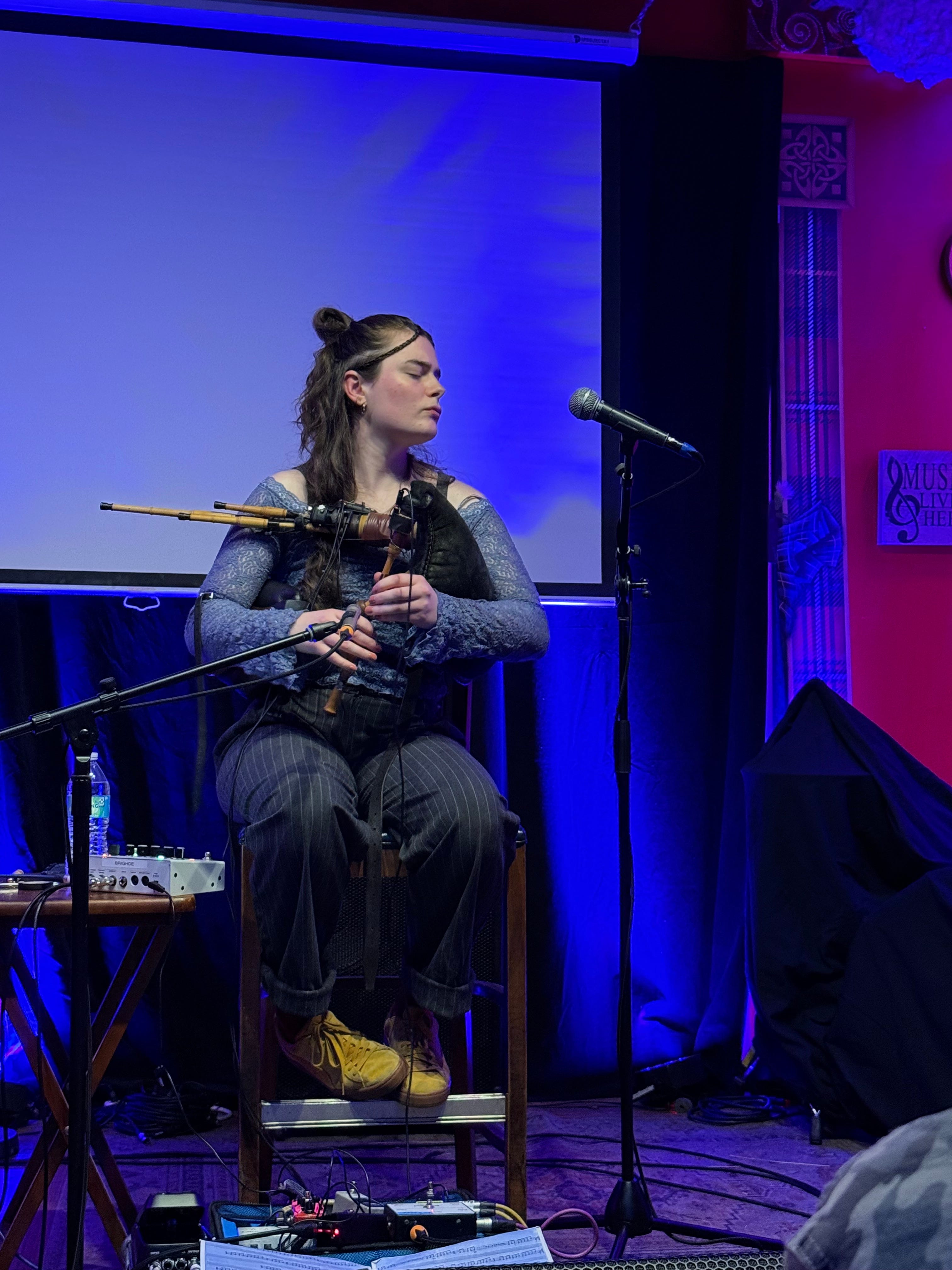
This year’s lineup included a cross section of contemporary folk scenes. The best sets came from Lankum, who have not played in this area in over a decade, and Brìghde Chaimbeul, whose sets marked the beginning of her first ever North American tour. These are two of the most exciting artists from the innovative Irish and Scottish scenes. Both draw on influences outside of folk—minimalism, drone, kosmische—to emphasize the droning and repetitive qualities of traditional music. As Lankum guitarist Daragh Lynch said, “It was great to be at the same festival as Neu! and beak>, since we’ve spent the last ten years trying to rip them both off.”
That’s a funny comment for an Irish band playing centuries-old traditional songs. But seeing Rother’s ecstatic set of Neu! and Harmonia songs just a couple hours before Lankum’s set—and at the same venue—it’s clear what Lynch is talking about. Both bands use the live setting to overwhelm an audience with the vibrating materiality of sound and the trance-like state of collective experience. This is nothing new for loud rock music, but it’s a real contrast with a lot of folk music from the era of studio recording and concert halls, which extracts folk songs from their original context as communal performance and dance music.
Bands like Lankum recreate some of this original experience through the tools that formally depart from tradition: walls of ambient sound, and arrangements that build trough gradual, long-form structures rather than pure repetition. A striking example is “Go Dig My Grave,” which singer Radie Peat said she learned from the recordings of Jean Ritchie. Ritchie sang the song as a solo ballad, or sometimes accompanied by Doc Watson on guitar. Lankum began their performance similarly, with Peat’s solo vocals first joined by sparse strumming, then gradually accumulating a mass of acoustic-electric sound that dissolve the vocals entirely. As Ian Lynch said, nothing was traditional when it was first done, and tradition is always changing and expanding its vocabulary.
Scottish piper Brìghde Chaimbeul similarly adds minimalist and electronic influences to Gaelic tradition. As she told me during our interview, the pipes were always a drone instrument—drones are what a piper always hears while performing. Her recordings use layering and echo effects, guest pipers and organists, and saxophonist Colin Stetson to expand her smallpipes into a galaxy of droning sounds that give the modern listener a taste of what the traditional performer hears. The more experimental albums (Carry Them With Us from 2023, and the forthcoming Sunwise) sound very studio driven, but when you see Chaimbeul perform you realize how close the tunes are to tradition. The manipulations are subtle; she performs solo with a few effects pedals for echo and reverb, and they cleanly blend into the natural drone of the pipes and sometimes with collaborators, like when she performed with Shahzad Ismaily at Big Ears. These techniques expand the natural range of her instrument rather than entirely transforming it;the solo pipes become a pipe band.
Another benefit to seeing this music live is that artists are able to preserve more of the storytelling character of traditional music. Chaimbeul explained the origin and meaning of the Gaelic songs; her upcoming album is thematically based on the wintertime gatherings (ceilidh) that center music and dance and storytelling. Lankum introduced each of their songs with amusing banter, telling stories about their songs or their sound guy’s adventures at the local bbq joint. Lankum also performed their song “The Rocks of Palestine,” which led the crowd to chant “Free, free Palestine” for several minutes. It was the most energized crowd I was part of during the weekend.
The American folk scene is less dynamic. The two major branches of progressive folk in the States, both well represented at Big Ears, are the post-bluegrass artists like Fleck and Edgar Meyer and the post-Fahey, “ambient country” ones like William Tyler and SUSS. Despite the apparent virtuosity of some of these artists, much of the music anonymizes folk traditions through the formal means of classical, light jazz, “world music,” and ambient influences rather than building on what their traditions do well. In contrast to the constant self-renewing experimentation that Fahey brought to each new album, most of his epigones seem content to buzz and strum in a vaguely pleasant pool of aimless sound. Guitar and banjo figurations float on liquid electronics and bowed strings, the music washing over and leaving nothing behind. Gone is the expressive substance of the blues and country, the rhythms of dance music, even the intentionality of environmental ambient. It works well enough as a Kelly Reichardt soundtrack, less so as a live performance.
Similarly, most of the recent work of Béla Fleck, including his lineup presented at Big Ears and their forthcoming album, brings diverse musical traditions together in what could be exciting improvisational collaborations (as the best of the progressive bluegrass tradition has been) but which in practice feels like a watering down of all the various parts. This is music for the Enlightened Liberal, the museum goer who wants to be told they’re cultured without researching or interrogating culture. The virtuosity is amazing, but after so many decades of hearing it in countless configurations, the virtuosity is not enough.
An antidote to the faults in both these categories is Magic Tuber String Band. The band’s earlier work showed the more direct absorption of Fahey and traditional songs, but their live set showed how they’ve evolved toward a more cohesive and original sense of composition. Violinist Courtney Werner’s classical training is obvious, but so is her experience with fiddling tradition: Old-time fiddle tunes develop seamlessly into glissando and extended techniques like scratch tone. Clawhammer banjo and blues guitar riffs feel at home next to imitations of bird call.. The structure of their compositions recalls Hindustani classical music, and in that sense the band is an heir to the psychedelic folk and “American primitivism” of the ’60s and ’70s.
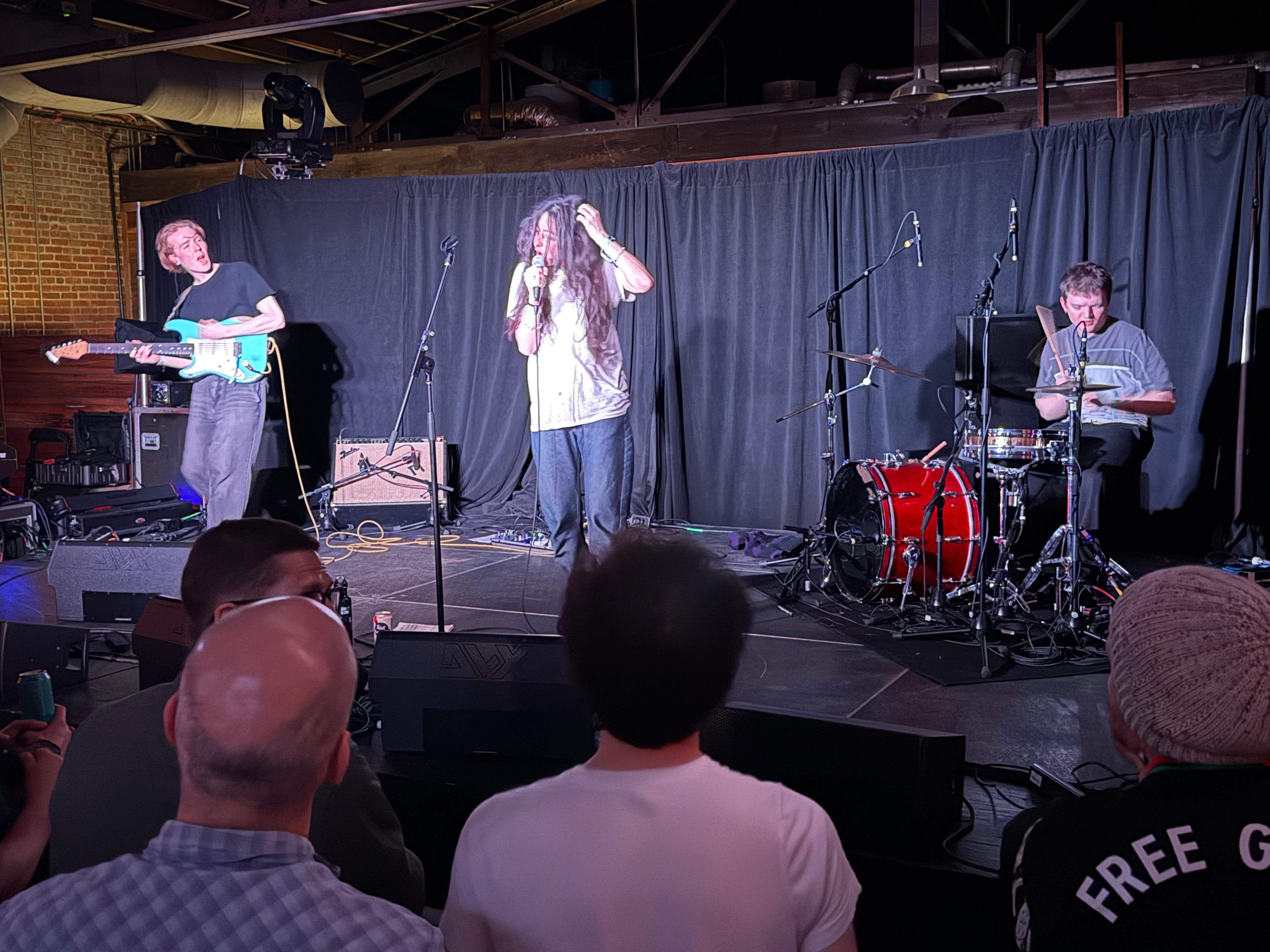
My weekend and my report have focused on folk and folk-adjacent music, but the best show of the festival was Still House Plants. It’s easy to claim that rock is dead, and many of the more successful rock groups at Big Ears and in general are either recycling sounds from the ’70s and ’90s or are themselves legacy acts from those decades (Michael Rother and Yo La Tengo arguably had great sets because they played their most classic material). But Still House Plants sounds like the future. The band live feels akin to the best of free jazz, the three members functioning as equal and independent voices in intimate conversation, unconcerned with the generically assigned roles of a standard rock trio. When one of them pauses or resumes the conversation or alters their rhythm, the texture of the whole is transformed; every such shift feels both surprising and structurally essential. Every song is an earworm despite the frequent lack of an apparent common meter or tonal structure. All it takes to be the best rock band of the decade is three brilliant musicians in perfect sync and a total lack of cliche.
Lovely piece! Nice to read such astute writing on Lankum and Brìghde Chaimbeul.