
Light Matter 2025

One of a handful of experimental film festivals in North America with a program broad enough and a director knowledgeable enough to offer something like a cross section of new work in the avant-garde, Light Matter begins today in Alfred, NY. (Another, newer and smaller component of the festival will be later this month in Buenos Aires.) The program is drawn almost entirely from submissions rather than invited work, so it especially leans toward newer and younger artists, but there are plenty of familiar names for those who keep up with this sort of filmmaking. I’m not attending in person, not just because of the distance but because this weekend is also my own local festival here in Knoxville, but I’ve seen all but a few of the films screening this weekend and wanted to quickly highlight some of my favorites.
On one stylistic end of the spectrum, there are artists working in a physical, analogue mode that continues the 16mm avant-garde tradition of Stan Brakhage, Andrew Noren, and so on. Shapeless Variations is the latest from Francisco Rojas, who’s been building one of the most significant new bodies of work in this mode of abstract light study. Like his earlier Sea of Glass, much of it consists of the play of light on water, a view which is here sometimes complicated by being filmed through patterns of foliage. The animating force of these films is the the rhythm of movement: the movement of the light as directed by moving water, the movement of focus on the lens, the movement of the edit.
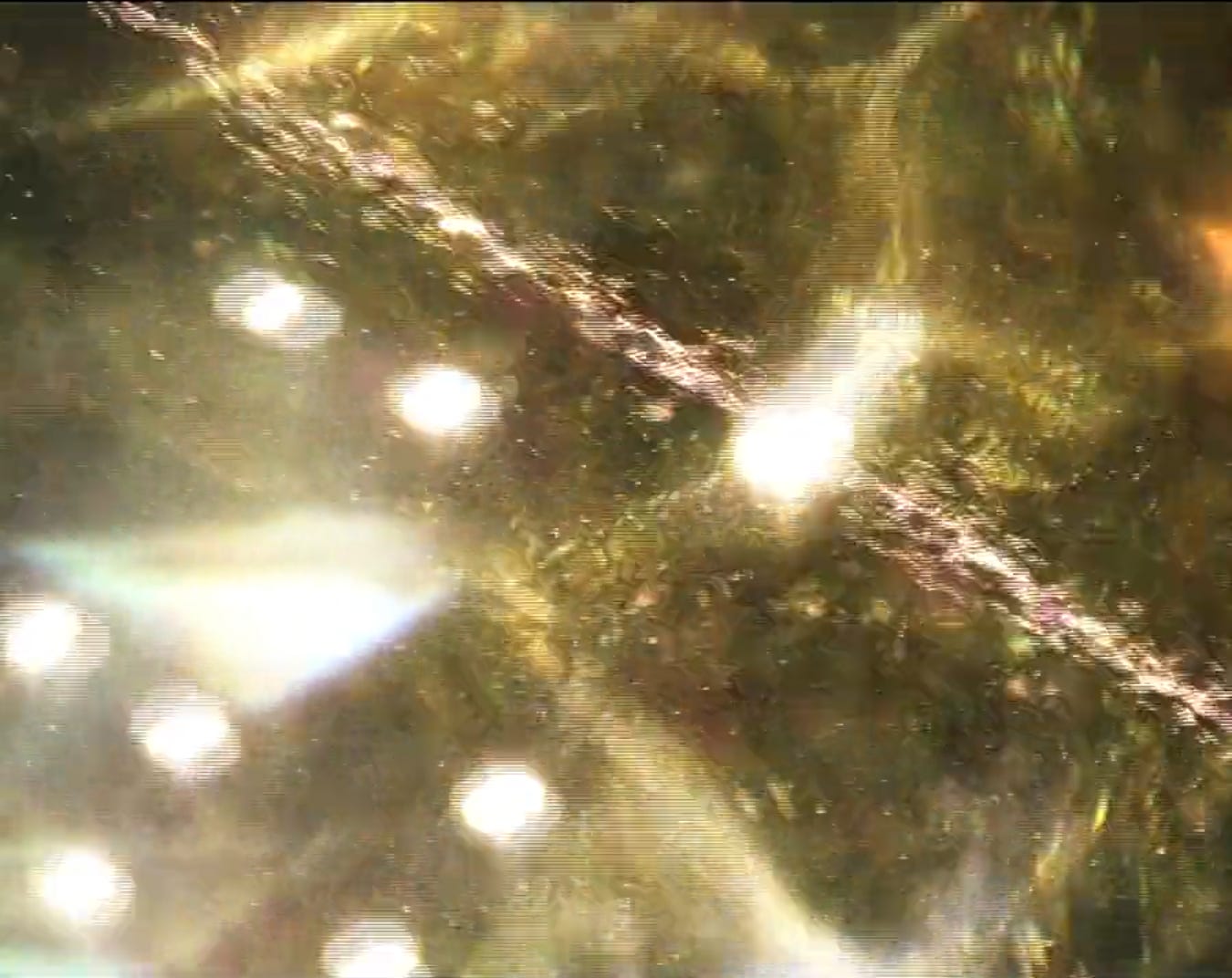
Using a camcorder rather than 16mm film, Rushnan Jaleel’s The Dithering Veil is nevertheless in a broadly similar stylistic vein, but with much more varied material. If I have one “complaint” after first viewing, it’s that the dazzling light and shadow play (sometimes featuring clouds and trees or a human face, sometimes too fully abstract to recognize objects as such) is so varied and impressive that I struggled to find the structure or sense of development. But that probably just means I need further viewings, which the film easily merits. (Jaleel has another new film this year, in thin air, which is just as good and more obviously structured around more limited material.)
A pointillist digital cousin to Dry Leaf’s smudgy pixelation, Francesco Zanatta’s River Nocturne (meditation on noise) also exploits the aesthetic potential of the technical margins of digital photography. Filmed at night and emphasizing the noise artefacts of low light camera tech, it allows this artificial grain to overwhelm the representational quality of the images. Zanatta also slows down the footage until it’s left with a pulsating quality of movement. Like Dry Leaf, much of its magic comes from how the “artificial” components of the image find shape and movement, a life of their own, independent of the camera or anything it’s pointed at.
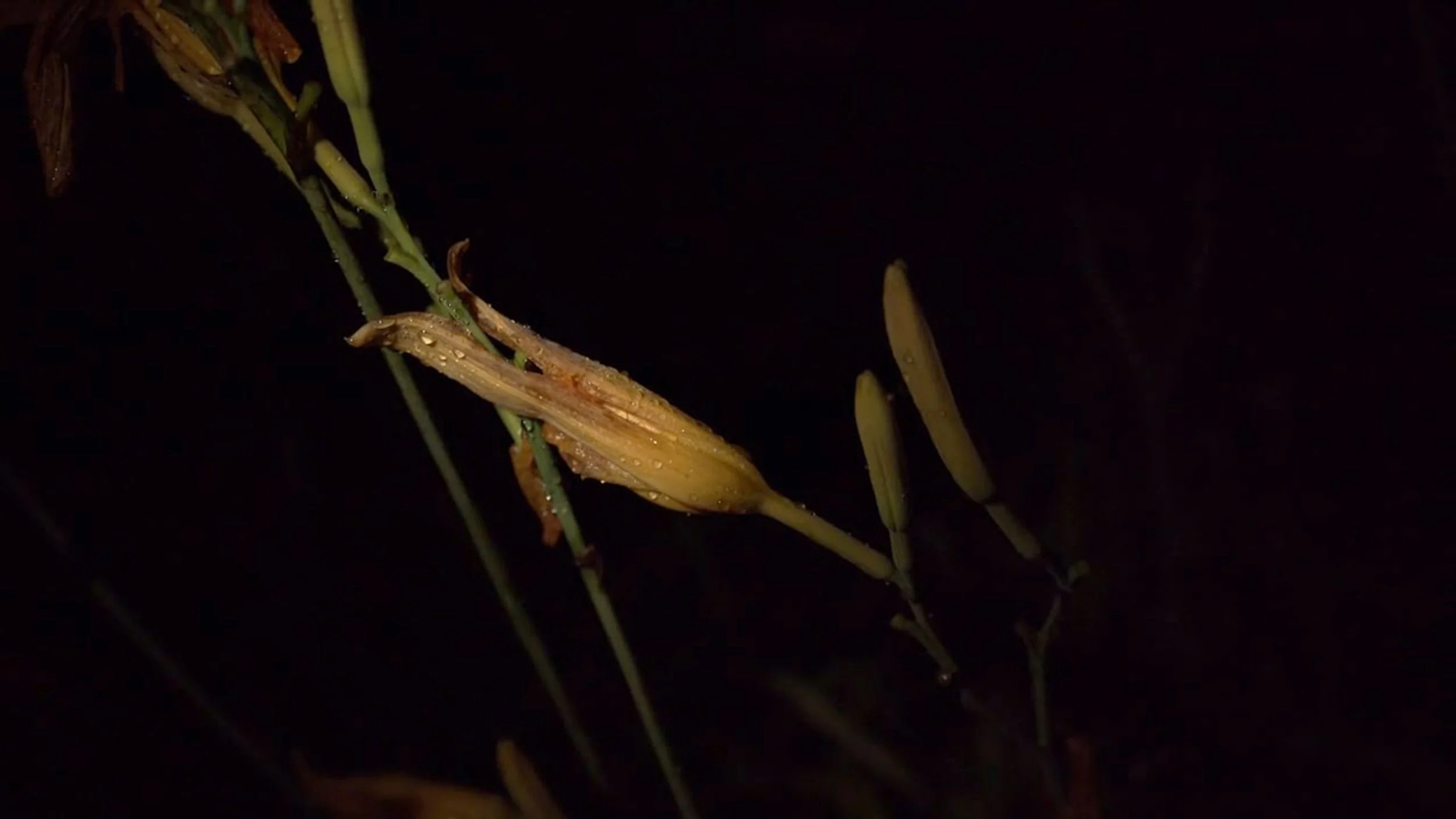
Another work that makes the best of low light settings, As An Earlier Wreck Is Now Cleared (Masha Vlasova) is perhaps my favorite of the entire program. The photography and sound design are equally beautiful, but it’s the semantic structure that makes this really special. Consisting of an introductory scene of floating white spots in the dark that are probably insects catching an off screen source of light (but which also suggest electricity or snowfall), a nocturnal trudge through a field illuminating flowers by flashlight, and a car ride with NPR playing, the work creates a sense of narrative flow without settling into a narrative as such. It demands interpretation while avoiding clarity. It belongs in a regrettably small category of narrative-adjacent experimental filmmaking that also includes Rhayne Vermette’s Levers and the work of Zachary Goldkind, and more distantly perhaps the earlier short films of Mary Helena Clark. This weekend’s screening is the work’s world premiere, but I hope it gets seen much more widely.
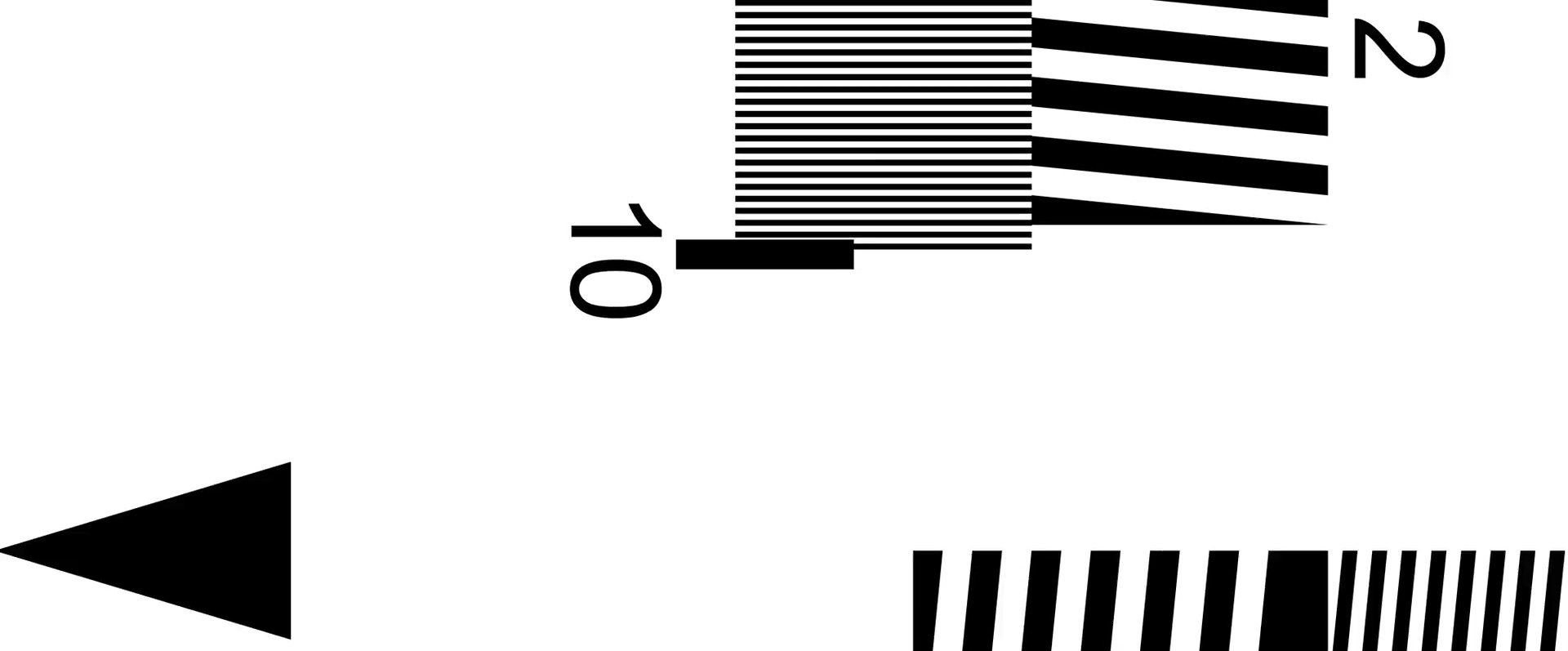
Max Hattler’s Norm is the first film to screen at the festival and another of its strongest entries. I previously knew Hattler for his stereoscopic work, which this technically isn’t, but it does trade in optical illusions of a sort that make patterns of black and white line seem to emerge spatially from the screen, generating depth and motion and even color that isn’t “there” in the sense of being visible in any single frame. It’s all composed, or animated if you will, from lens and monitor test charts, and the images do double duty as the source of a very effective optical soundtrack. You could consider this part of the “visual music” tradition that goes back to Oskar Fischinger, Len Lye, and so on.
I previously wrote about Half Halt, the delightfully playful new film by Sofia Theodore-Pierce, as part of In Review Online’s coverage of the Crossroads festival. Here’s what I wrote:
Sofia Theodore-Pierce pushes even harder (and even more playfully) on conventions of spatial representation in Half Halt. She works with a handful of basically simple materials—two friends talk as a lift ascends and descends, someone reads their poem, the artist films and is filmed while riding a horse—but jumbles these materials into intricately complicated combinations. We hear the elevator while seeing a blank screen, see the elevator while hearing what seems to be a train, witness the poetry reading at a maddening off-sync delay, and finally watch the frame freeze altogether and simply end without resolution as if the file were corrupt. Formally, we are denied every expected satisfaction, including any direct articulation of theme; the film works through a constant skirting around, showing us how it was made but not what it’s about. But every sound and image is tied together by the friendship of the artist and her collaborators, offering a comfort and support that the edit does not.
There are a number of other works in this program which deserve more careful attention than I have time to give them. Alexis McCrimmon’s Remote Views is a very strong work remixing and manipulating archival materials from 1980s Black media, including public television. Toward a Fundamental Theory of Physics (Victor Van Rossem) is probably my favorite natively 3D experimental work of the last several years not made by Blake Williams. The new works by Sarah Ballard, Yannick Mosimann, Richard Tuohy, Mahda Purmehdi, Nicole Remy, Zazie Ray-Trapido, Eislow Johnson, Clint Enns, Malic Amalya, Tristan Ives, and numerous others are well worth seeing. (And it’s worth noting that I also hated a few films on the more virtual, artificial intelligence side of the spectrum, which may or may not be a desired effect of the programming.) Please look out for all of these, and write something if you catch up with them.